
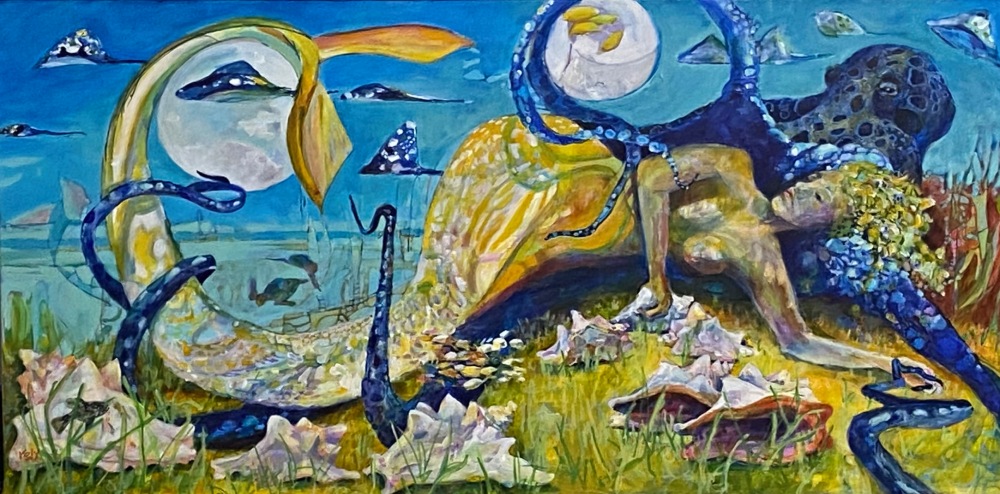
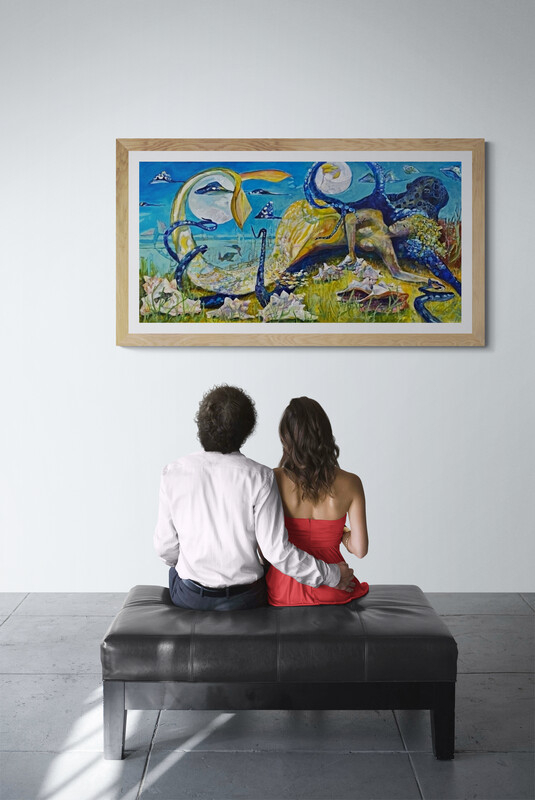
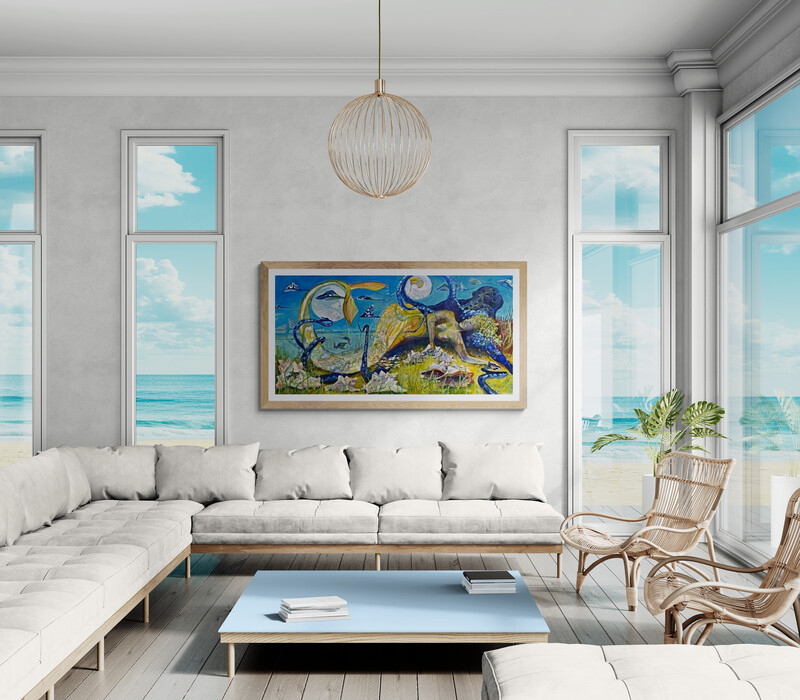
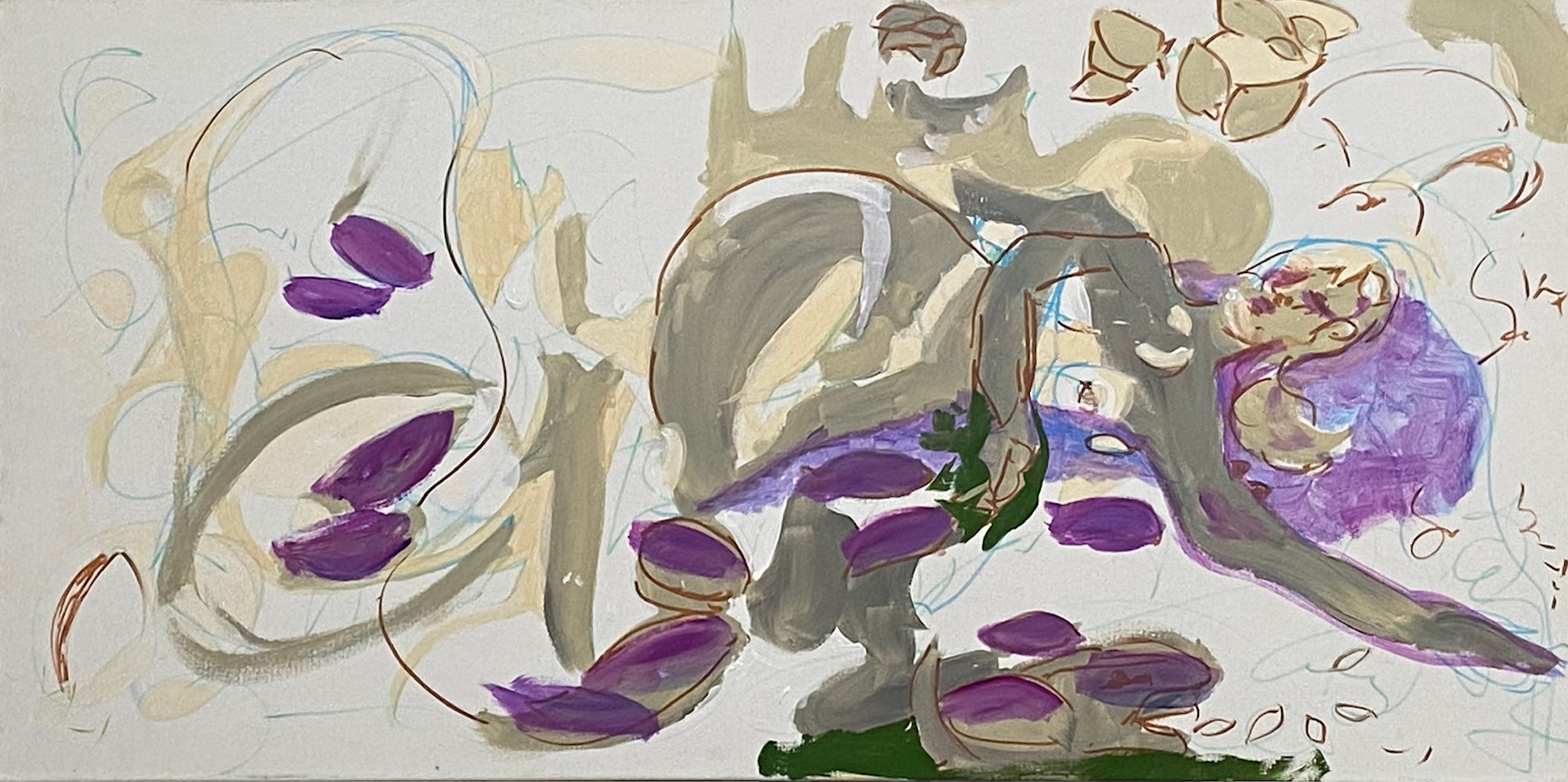
Once in a Blue Moon is one of those paintings where you feel, almost immediately, that a lot is happening — and that it’s happening on purpose. It’s submerged, mythic, slightly uncanny, drawing from real creatures and real relationships while allowing space for something imagined to exist among them.
The scene unfolds on a conch bed, and that matters. Conch are known to gather in large numbers, and here they do so in a way that feels abundant and right — not threatened, not harvested, not disappearing. In the real world, conch are increasingly depleted and removed from their ecosystems, but in this painting they remain together, present in their full and marvelous multitude.
At the center, a feminine figure rests. She is not posed, not guarded, not performing anything. She trusts where she is. That sense of safety is striking, especially given what surrounds her.
Nearby, the octopus holds its ground. It is blue, strong, unmistakably capable. A blue-ring octopus is not something to take lightly — its power is absolute. And yet here, that power is restrained. The octopus does not advance; it supports. Its arms move through the space with care, offering contact, comfort, and communion rather than harm. This is masculine power fully intact, choosing relationship over dominance.
Above, eagle rays glide through the water column — effortless, formidable, perfectly at home in their scale. They bring awe without intrusion, passing through rather than pressing down.
If you look closely, quieter presences emerge. Two turtles move with their own ancient calm. A single conch fish slips among the shells, easy to miss but essential. Small relationships that quietly hold the larger system together.
Color binds everything. Blues dominate without cooling the painting down, while golds and yellow-greens glow softly through shells, bodies, and water — closer to bioluminescence than light. Warm and cool coexist without struggle.
And then there are the two moons — not a metaphor so much as a condition. A blue-moon month. Rare, real, and slightly disorienting. The kind of alignment that doesn’t last, but while it does, changes how everything feels.
What gives the painting its charge is not any single symbol, but the way they coexist: masculine and feminine, danger and trust, abundance and loss, stillness and motion. Nothing is simplified. Nothing is neutralized.
It feels like witnessing something that doesn’t happen often — but does happen — when conditions are right.


